
In the shipping industry, ensuring the absolute tightness of hatch covers is critical to protecting cargo and avoiding massive insurance claims. Recently, more customers have been searching for Ultra Sonic Hatch Cover Test Equip as a reliable, high-efficiency alternative to the traditional Hose Test.
If you are deciding which testing method to use, this article breaks down how ultrasonic technology solves the core pain points of modern vessel operations.
1. Moving Beyond the Limitations of the Traditional Hose Test
For a long time, the Hose Test has been the standard for checking hatch cover seals. However, this method has significant drawbacks that often fail to meet modern maritime requirements:
- Environmental Constraints: Hose testing cannot be performed in freezing temperatures (as water freezes) or when the vessel is already loaded with cargo, which risks damaging sensitive goods.
- Lack of Quantification: A hose test only tells you if there is a leak; it cannot pinpoint the exact degree of seal compression or detect microscopic gaps before they become major problems.
- Pollution and Cleanup: The process generates large amounts of runoff water, which can contaminate port environments and requires time-consuming cleanup.
2. Pain Points Solved by Ultra Sonic Hatch Cover Test Equip
Looking for Ultra Sonic Hatch Cover Test Equip? Learn how ultrasonic testing outperforms hose tests by preventing cargo damage and increasing vessel inspection efficiency.
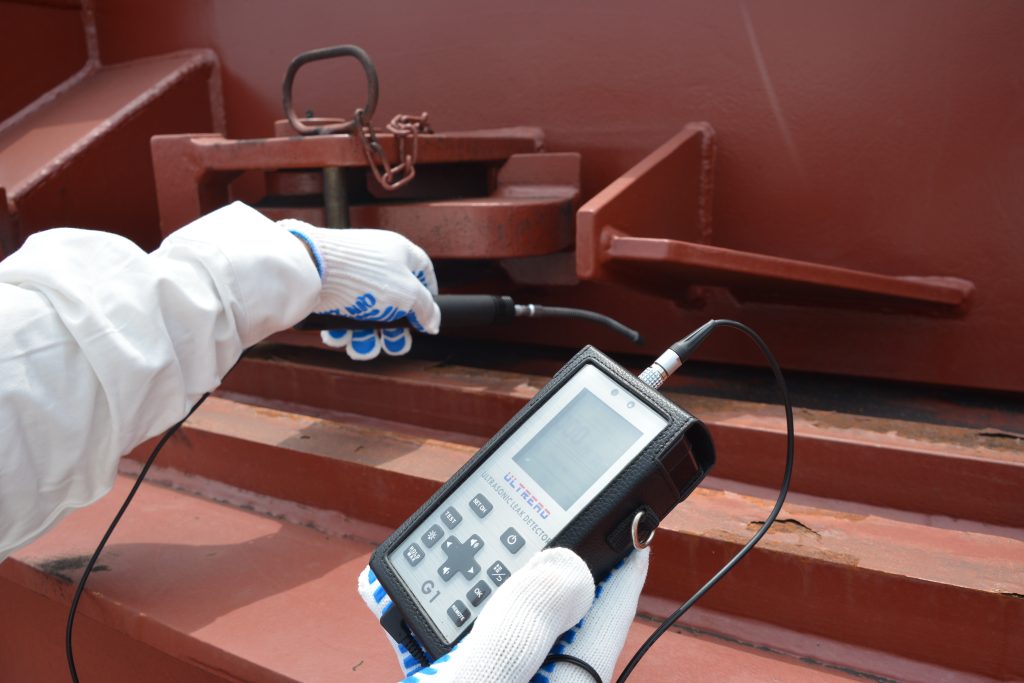
Using an ultrasonic hatch cover tester eliminates these issues and provides several key advantages:
Precise Location and Pre-emptive Warnings
Ultra Sonic Hatch Cover Test Equip uses the penetrative properties of ultrasonic waves. Even micron-level gaps that are invisible to the eye are captured by the sensitive receiver. It doesn’t just find existing leaks; it evaluates the compression status of the rubber packing to predict potential risks.
All-Weather, All-Scenario Application
Whether you are in a polar region or the ship is fully loaded with precision instruments or bulk grain, ultrasonic testing works perfectly. It requires zero water and poses zero risk to the cargo.
Efficiency with Single-Person Operation
While a hose test requires multiple crew members on deck and inside the hold, an ultrasonic test can usually be completed by a single operator. This significantly reduces inspection time, saving shipowners and charterers expensive laytime costs.
3. Why Choose Our Ultrasonic Detection Solutions?
When selecting your Ultra Sonic Hatch Cover Test Equip, professionalism and compliance are the top priorities:
- Compliant with Class Standards: Our equipment is designed in accordance with the inspection guidelines of major Classification Societies (such as DNV, LR, and BV), ensuring results are recognized globally.
- User-Friendly Interface: Even non-technical crew members can operate the device after brief training, with clear, intuitive digital readings.
- Ruggedized for the Sea: Built for harsh maritime environments, our devices are shockproof and moisture-resistant—the perfect tool for marine surveyors and crew alike.
Conclusion
In today’s competitive shipping market, relying on traditional hose testing is no longer enough for complex risk management. Investing in high-performance Ultra Sonic Hatch Cover Test Equip is not just about passing an inspection, it’s about providing an “invisible” insurance policy for your cargo.
If you’d like to learn more about technical specifications or request a quote, feel free to contact us today.